Saturday, August 26, 2017

Herzl vs. Bibi


The English will follow the Hebrew

.קונגרס הציוני הראשון התקיים בין 29 ל31 באוגוסט, 1897, כלומר, לפני 120 שנה
:לאחר הקונגרס, הרצל כתב בעיתונו, ב10 לספטמבר

מסתבר שלרעיון הלאומי היהודי הכח המאחד אנשים בעלי הבדלי שפה, הבדלים חברתיים,  פוליטיים ודתיים לשלם אחד
בהסתתו, שממשיכה יותר מעשרים שנה, הן כמנהיג האופוזיציה בתקופת רבין בתחילת שנות התשעים, הן כראש הממשלה בהווה, נתניהו עושה כל מאמץ (מוצלח מבחינתו) להפריד בין חלקי העם ולהסית נגד כל מי שחושב אחרת ממנו
ללא רמז של יושרה או רסן, הוא עושה הכל כדי לפרק את המרקם העדין של החברה הישראלית, באמצעות שחיתות והסתה

לצערינו, חברי הממשלה, הן ממפלגתו של נתניהו, הן מהמפלגות הקואליציה, שותקים. כפי שאלי ויזל אמר, הצופה מן הצד, ושותק, רע יותר לקורבן מן התוקפן עצמו

למזלנו, ישנם אנשים, ארגונים ומוסדות שפועלים בארצינו הקרועה ואהובה כדי לשמור ולהגן על הדמוקרטיה והשפיות

כמה הערות ביחס להפגנות פתח תקוה:
היועץ המשפטי לממשלה מנדלבליט אינו חלק מהרשות השופטת, אלא מהרשות המבצעת, מינוי אישי של ראש הממשלה נתניהו. לכן הפגנה מול ביתו או במרחק מאות מטרים מביתו אינה דומה להפגנה מול בית של שופט.
בנובמבר 2016 מנדלבליט הכריז שאין חשד לפלילים בפרשת הצוללות. איך ידע?
הפגנות פתח תקווה החלו בנובמבר 2016 כדרישה ממנדלבליט לא לגרור רגליים ולהתחיל בחקירות או להתפטר. 
היום יש חקירה ועד מדינה, לא רק בפרשה זו, אלא בפרשות נוספות שסיומן מתעכב.
עד כה, מי ומה השפיע יותר על היועץ המשפטי לממשלת נתניהו - נתניהו או העם שדורש חקירות יעילות של השחיתות?

בין 1984 ל 1987 דתיים לאומיים וחרדים הפגינו במוצ״ש נגד פתיחת קולנוע בשבת בפתח תקוה. גם כאשר בג״צ אסר על ההפגנות, המשיכו אלפים להפגין. היכן הם היום בהגנה על הזכות הדמוקרטית לחופש הביטוי?
Herzl on the balcony in Basel


The first Zionist Congress was held in Basel, August 29-31, 1897, that is, 120 years ago.

Following the Congress, Herzl wrote a piece in Die Welt, September 10:
"[I]t turned out that the Jewish national idea possesses the unifying power to wield together people with linguistic, social, political, and religious differences into one united whole. . . . "
Netanyahu on the balcony at Zion Square
With his incitement, which has continued over twenty years, both as leader of the opposition during the premiership of Yitzhak Rabin in the early 1990s, and presently as Prime Minister, Netanyahu makes every possible (and from his point of view successful) effort to divide, instigating against those who think differently from him, rather than to bring "together people with linguistic, social, political, and religious differences into one united whole."
Without any sense of integrity or inhibition, he is doing whatever he can to destroy the fabric of Israeli society, by corruption and incitement.
Tragically, the members of the government, from his own party and his coalition partners, remain silent. They have turned into bystanders, who, as Elie Wiesel said, are worse to the victims than the aggressor.


Fortunately, there are people, organisations and institutions in this torn country who stand up to defend and protect democracy and the sanity of this beloved country.


The Hero and His Shadow
Psychopolitical Aspects of Myth and Reality in Israel

 Contents

Preface       The Beggar in the Hero’s Shadow      
Chapter 1    Return to the Source               
Chapter 2    From My Notebook             
Chapter 3    From Dream to Reality             
Chapter 4    Origins and Myths             
Chapter 5    From Redemption to Shadow         
Chapter 6    Wholeness Apart               
Chapter 7    Myth, Shadow and Projection      
Chapter 8    A Crack in the Mask          
Chapter 9    The Death of the Mythical and the Voice of the Soul


available on Kindle ($9.99) and in paperback ($29.00)


Sunday, August 20, 2017

When Bibi's bubble bursts


PM. Netanyahu, leader of the most extreme and anti-democratic government that has ever ruled in Israel, has declared that he is no longer Prime Minister of the entire population, inciting against the left, the media, Arabs, and whoever does not directly swear allegiance to him.
The police was ordered on August 19 to prevent the demonstrations against his corruption, carried out hundreds of meters from the home of the Attorney General, and the arrest of leaders of the manifestation. 
One of the reasons given by the police was "undue pressure" on the AG. 
The AG is a political appointee, by Netanyahu, and not a civil servant in the Department of Justice. He has severely delayed the corruption investigations against Netanyahu, a great many of whose government ministers and advisers have been tried and judged or are under investigation for a variety of crimes, many of them on charges of corruption.
It is not the task of the police to determine if demonstrators exert due or undue pressure.

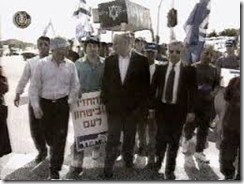
The photo above is from a demonstration against the policies of Yitzhak Rabin, in 1995, where Netanyahu marches in front of a 'coffin' that bears Rabin's name.
The inflamed atmosphere, of which Netanyahu as then leader of the opposition was partly responsible, led up to Rabin's assassination.
Netanyahu should be tried for this, as well as his present incitement and the crimes presently under investigation. The fact that 22 years have passed should at least not make us forget.

When Bibi's bubble bursts, and it will, sooner rather than later, the extreme right in Israel will have a harsh awakening. The more moderate right, which has collaborated by silence and participation, will have a shameful awakening that fascism can take grip of any society, if the watchdogs are not constantly on the alert.


The Hero and His Shadow 
Psychopolitical Aspects of Myth and Reality in Israel


 Contents

Preface       The Beggar in the Hero’s Shadow      
Chapter 1    Return to the Source               
Chapter 2    From My Notebook             
Chapter 3    From Dream to Reality             
Chapter 4    Origins and Myths             
Chapter 5    From Redemption to Shadow         
Chapter 6    Wholeness Apart               
Chapter 7    Myth, Shadow and Projection      
Chapter 8    A Crack in the Mask          
Chapter 9    The Death of the Mythical and the Voice of the Soul

available on Kindle ($9.99) and in paperback ($29.00)

Dedication of The Hero and His Shadow

I dedicate this book to those, all too many, whose voices were silenced by man’s evil.
   I dedicate it to those, all too few, who raise their voice against fascism, who speak up in the struggle for peace and reconciliation, especially between Palestinians and Israelis, incessantly on the verge of yet another cycle of violence and hostilities.
   I dedicate it to those who try to hold the vulnerable balance in that ultimate conflict of Abraham between Father and Son, divine and human, idea and implementation, past and future, ego and self.
   I dedicate this book to the daughters and the sons whose future is endangered.


Friday, August 11, 2017

The Human Soul (Lost?) in Transition, at the Dawn of a New Era - Quadrant


This essay, in the Spring 2017 issue of Quadrant, examines the liminal phase of society and interiority in which we find ourselves today and poses several questions to the irrepressibly optimistic inventors of a techno-utopian future: Can we really be and feel happy if we need to be informed about it by a cellphone app? Do 93 million selfies a day replace a single moment of true reflection? How can we remain relatively integrated individuals in the transiency of the present?

The essay will be part of a forthcoming book.


From the introduction:
Jung says, “Whoever speaks in primordial images speaks with a thousand voices…,” and “In each of these images there is a little piece of human psychology and human fate, a remnant of the joys and sorrows that have been repeated countless times in our ancestral history…” (CW15, par. 129, 127).
The image, the images of interiority, cannot exist without the soul. In soullessness, in fundamentalism and totalitarianism there are no images.The existence of the soul, that elusive, purely poetical idea of anima, whether in man or woman, cannot be bound by earthly empires, neither by imperial rules nor by imperatives, but can only be poetically imagined, for instance, as that image of a mirror that mirrors the image.
But the soul also relies on the capacity of imagelessness, in the sense of an absence of externally generated images. In their discussion centered around Neumann’s manuscript on Jacob and Esau, Jung writes that “the ‘imagelessness’ [that is, of the God-image] is exceedingly important for the free exercise of intuition that would be prejudiced by a fixed image, and thereby rendered unusable.” (Jung and Neumann, 2015, p. 56).
While images take shape within our individual psyches, the image is not only within us, but we are also within the image, as Henry Corbin says (Cheetham, 2003, p. 71). We reside within an image of the world, within the world soul, and we relate to the world according to the images, ideas and perspectives that we have developed, and to a large extent, according to the views and the spirit of our times.
When listening to the brilliant young men and women at the forefront of progress, those that hold the trigger to the chips and the apps of the future, one cannot refrain from being amazed at the firm belief and complete conviction that technology is the remedy of all ills and the foundation of all future viruses – sorry! virtues, not viruses.
This essay is an attempt to cause a slight crack in the confidence of the young, and perhaps it is merely an old man’s pathetic envy of tomorrow’s triumphant heroes, to whisper in their ears, “you are also mortals.” .....

Quadrant, Spring 17 - Volume XLVII:1

— Kathryn Madden
— Shaun McNiff
— Erel Shalit
— Brandon J. O'Neil
— Elizabeth Colistra
— Roger Peasley
— 
Beth Darlington, review editor. Reviews by Deborah Stewart, Mark Dean, and Chris Beach


Wednesday, August 2, 2017

Cykl życia. Archetypowa droga człowieka - The Cycle of Life: Themes and Tales of the Journey - now in Polish


The Polish edition of The Cycle of Life: Themes and Tales of the Journey
Translation by Karol Domanski and Adam Kosciuk.
Introduction by Aleksandra Szczepaniak
Design: Marta Rydz

 From the introduction by Aleksandra Szczepaniak:
               This is a journey leading us along the paths of human life. It is also an introduction to the art of amplification that being a method of broadening of the meaning through myths, legends, tales and stories from the cultural treasury of the world. It illustrates the river-like course of human life. It is only the image that can fully reflect the process and the interweaving of plots and motives of psychic life. This book is like a current of a river - sometimes it flows slowly and clearly, sometimes it speeds up falling into meanders of meanings and nuances. Its tone rises and falls - short phrases change into descriptions filled with silence. In a way, through its changing dynamics,it reflects the process of Jungian analysis –here, likewise, various stories mingle in the analytical vessel.The authour sometimes speaks with the voice of Puer, joyous and vivacious, sometimes he sounds like Senex and at other times he falls into a discourse so characteristic for Jewish culture of which he is a representative.

I would like to thank Aleksandra, Karol, Adam, Marta, and all those who have worked to enable the publishing of the book in Polish. They have all been incredibly devoted and done a wonderful job - THANK YOU!

Już w piątek ukaże się polskie wydanie książki "Cykl życia. Archetypowa droga człowieka" autorstwa Erela Shalita w tłumaczeniu Karola Domańskiego i Adama Kościuka.

Według teorii Junga życie człowieka składa się z kilku etapów. Faza pierwsza, obejmująca dzieciństwo i młodość, jest adaptacją do świata zewnętrznego; faza druga, dojrzałość, to adaptacja do świata wewnętrznego; faza trzecia, starość, jest adaptacją do śmierci. Erel Shalit podkreśla, że rozwój człowieka trwa przez całe życie i ma charakter nie linearny, a cyrkularny. W istocie jest cyrkumambulacją – okrążaniem znaczenia.

(...) Ta książka nie jest łatwa – autor prowadzi Czytelnika przez meandry życia i rozwoju, wprowadzając w świat znaczeń, których nie dostrzegamy w pędzie współczesnego świata. Wiedzie nas przez przestrzeń wewnętrzną, której portalami są marzenia senne, zapomniane opowieści, mity i dzieła literackie. Opisuje proces, którego nie da się w pełni przekazać, można go jedynie zobaczyć czy poczuć za pośrednictwem zmieniających się obrazów.

Z Przedmowy do wydania polskiego

Aleksandra Szczepaniak
analityk jungowski
Polskie Towarzystwo Psychologii Analitycznej

Książkę można nabyć tutaj


Watch Cycle of Life on YouTube, with Polish subtitles, part 1part 2.

Tuesday, August 1, 2017

Renewed website


Renewed website

You are invited to visit my renewed website, here. You will find links to YouTube presentations, material on Jung and Neumann, my books, and useful resources.
Thank you for your interest – any and every comment or correction will be appreciated!


Tuesday, July 25, 2017

Amplification: A Personal Narrative, by Tom Singer

The following is an excerpt from Tom Singer's chapter in The Dream and its Amplification.

Introduction
Amplification as an idea or a technique is relatively easy to understand. As a living reality, it is far more elusive to evoke than to explain. The lived reality of weaving an amplification can take on a richness and texture that is as elegant as any of the finest fabrics in the world. And amplification, when lived, is a fabric that is woven by time, memory, image, feeling, sensation, idea and perhaps even a glimpse, at times, of divinity.
The goal of amplification is to catalyze a transformative process in the relationship between the personal, cultural and archetypal levels of the psyche. The study and use of amplification should begin with the specificity and uniqueness of an individual's life that expands into the life of specific cultures, and ultimately finds its roots in the archetypal or universal dimensions of human experience. The quest to find meaning in symbolic imagery by tapping into archetypal sources can transform an individual's life trajectory and release unexpected creative energies.  

Personal Story and Original Dream Image
This chapter offers a personal narrative of my experience of amplification. The initial context and setting for this story occurred more than forty years ago and remains alive inside me to this day because the wondrous thing about an amplification living in the psyche is that it continues to weave its magic and meaning over time, as long as one pays attention to it.   In the fall of 1965, I enrolled as a first year student at Yale Medical School, having just returned from a year of teaching in Greece following graduation from college.  The year in Greece had been one of glorious discovery and the awakening of a thirst for life. I imagined myself following in the footsteps of Nikos Kazantzakis and his Zorba the Greek. I explored modern Greece, its magnificent landscapes and people, always accompanied by the haunting memories of earlier eras that murmur to one in the stones, the trees, the sky, the sea. 
You might imagine how I felt when I returned to the United States and moved into the medical school dorm. New Haven was quite a long way from Greece and quite a brutal way to sober up from the intoxication of Greek adventures. My newly acquired taste for life vanished almost instantaneously .  I felt a dread settle over me.  Most of my classmates came charging into medical school, armed with anatomy, physiology, microbiology and the other basic medical sciences already under their belt from undergraduate studies. I had taken my basic premedical course early in college and hadn’t taken a science course in three years.. Yale was enormously forgiving and, unlike any other medical school in the country, had almost no exams for the first two years which afforded me some time to get my feet on the ground.  Yale had the strange idea that the students they admitted would find their way and didn’t need to be sadistically tortured into becoming good doctors. So, I found myself desperately struggling to catch up in the first two years but not flunking out because we had no tests or grades.
.....

Fig. 4. Cecrops, King of Athens, upper half as civilized statesman, lower half as coiled snake’s tail
 (Harrison 1912, 263) 

Thomas Singer, M.D. is a psychiatrist and psychoanalyst in the San Francisco Bay Area who writes about culture, psyche, and complex from a Jungian perspective. He is currently at work on a series of books that explore cultural complexes in different parts of the world.  The first two volumes, Placing Psyche: Exploring Cultural Complexes in Australia and Listening to Latin America, have been published in the Spring Journal Books series of Analytical Psychology and Contemporary Culture of which he is the series editor. Other recent Spring books that he has edited include Psyche and the City: A Soul's Guide to the Modern World and Ancient Greece, Modern Psyche: Archetypes in the Making. Dr. Singer also has a long-term interest in the Archive for Research in Archetypal Symbolism (ARAS) and serves on its National Board.


The Dream and its Amplification is available on 
Book DepositoryBooks-a-Million, and other book sellers.

Thursday, July 13, 2017

Remarks by Prime Minister Yitzhak Rabin on Receiving the Nobel Prize for Peace


Image result for rabin nobel peace prize

Oslo
December 10, 1994


Your Majesties,
Esteemed Chairman and Members of the Norwegian Nobel Prize Committee,
The Honorable Prime Minister of Norway,
My Fellow Laureates, Chairman Arafat and the Foreign Minister of Israel Shimon Peres,

Distinguished Guests,

At an age when most youngsters are struggling to unravel the secrets of mathematics and the mysteries of the Bible; at an age when first love blooms; at the tender age of sixteen, I was handed a rifle so that I could defend myself.

That was not my dream. I wanted to be a water engineer. I studied in an agricultural school and I thought being a water engineer was an important profession in the parched Middle East. I still think so today. However, I was compelled to resort to the gun.
I served in the military for decades. Under my responsibility, young men and women who wanted to live, wanted to love, went to their deaths instead. They fell in the defense of our lives.

Ladies and Gentlemen,

Image result for rabin mount scopus 1967In my current position, I have ample opportunity to fly over the State of Israel, and lately over other parts of the Middle East as well. The view from the plane is breathtaking; deep-blue seas and lakes, dark-green fields, dune-colored deserts, stone-gray mountains, and the entire countryside peppered with white-washed, red-roofed houses.

And also cemeteries. Graves as far as the eye can see.
Hundreds of cemeteries in our part of the world, in the Middle East -- in our home in Israel, but also in Egypt, in Syria, Jordan, Lebanon. From the plane's window, from the thousands of feet above them, the countless tombstones are silent. But the sound of their outcry has carried from the Middle East throughout the world for decades.
Standing here today, I wish to salute our loved ones -- and past foes. I wish to salute all of them -- the fallen of all the countries in all the wars; the members of their families who bear the enduring burden of bereavement; the disabled whose scars will never heal. Tonight, I wish to pay tribute to each and every one of them, for this important prize is theirs.
Ladies and Gentlemen,

I was a young man who has now grown fully in years. In Hebrew, we say, 'Na'ar hayiti, ve-gam zakanti' [I was a young man, who has grown fully in years]. And of all the memories I have stored up in my seventy-two years, what I shall remember most, to my last day, are the silences: The heavy silence of the moment after, and the terrifying silence of the moment before.

As a military man, as a commander, as a minister of defense, I ordered to carry out many military operations. And together with the joy of victory and the grief of bereavement, I shall always remember the moment just after taking such decisions: the hush as senior officers or cabinet ministers slowly rise from their seats; the sight of their receding backs; the sound of the closing door; and then the silence in which I remain alone.

That is the moment you grasp that as a result of the decision just made, people might go to their deaths. People from my nation, people from other nations. And they still don't know it.
At that hour, they are still laughing and weeping; still weaving plans and dreaming about love; still musing about planting a garden or building a house -- and they have no idea these are their last hours on earth. Which of them is fated to die? Whose picture will appear in the black frame in tomorrow's newspaper? Whose mother will soon be in mourning? Whose world will crumble under the weight of the loss?

As a former military man, I will also forever remember the silence of the moment before: the hush when the hands of the clock seem to be spinning forward, when time is running out and in another hour, another minute, the inferno will erupt.

In that moment of great tension just before the finger pulls the trigger, just before the fuse begins to burn; in the terrible quiet of the moment, there is still time to wonder, to wonder alone: Is it really imperative to act? Is there no other choice? No other way?
'God takes pity on kindergartners,' wrote the poet Yehudah Amichai, who is here with us this evening -- and I quote his:

'God takes pity on kindergartners,
Less so on the schoolchildren,
And will no longer pity their elders,
Leaving them to their own,
And sometimes they will have to crawl on all fours,
Through the burning sand,
To reach the casualty station,
Bleeding.'

For decades, God has not taken pity on the kindergartners in the Middle East, or the schoolchildren, or their elders. There has been no pity in the Middle East for generations.

Ladies and Gentlemen,

I was a young man who has now grown fully in years. And of all the memories I have stored up in my seventy-two years, I now recall the hopes.

Our people have chosen us to give them life. Terrible as it is to say, their lives are in our hands. Tonight, their eyes are upon us and their hearts are asking: How is the power vested in these men and women being used? What will they decide? Into what kind of morning will we rise tomorrow? A day of peace? Of war? Of laughter? Of tears?

A child is born in an utterly undemocratic way. He cannot choose his father and mother. He 
cannot pick his sex or color, his religion, nationality or homeland. Whether he is born in a manor or a manger, whether he lives under a despotic or democratic regime is not his choice. From the moment he comes, close-fisted, into the world, his fate -- to a large extent -- is decided by his nation's leaders. It is they who will decide whether he lives in comfort or in despair, in security or in fear. His fate is given to us to resolve -- to the governments of countries, democratic or otherwise.

Ladies and Gentlemen,

Just as no two fingerprints are identical, so no two people are alike, and every country has its own laws and culture, traditions and leaders. But there is one universal message which can embrace the entire world, one precept which can be common to different regimes, to races which bear no resemblance, to cultures that are alien to each other.

It is a message which the Jewish people has carried for thousands of years, the message found in the Book of Books: 'Ve'nishmartem me'od l'nafshoteichem' -- 'Therefore take good heed of yourselves' -- or, in contemporary terms, the message of the sanctity of life.

The leaders of nations must provide their peoples with the conditions -- the infrastructure, if you will -- which enables them to enjoy life: freedom of speech and movement; food and shelter; and most important of all: life itself. A man cannot enjoy his rights if he is not alive. And so every country must protect and preserve the key element in its national ethos: the lives of its citizens.

Only to defend those lives, we can call upon our citizens to enlist in the army. And to defend the lives of our citizens serving in the army, we invest huge sums in planes and tanks, and other means. Yet despite it all, we fail to protect the lives of our citizens and soldiers. Military cemeteries in every corner of the world are silent testimony to the failure of national leaders to sanctify human life.

There is only one radical means for sanctifying human life. The one radical solution is a real peace.

Ladies and Gentlemen,

The profession of soldiering embraces a certain paradox. We take the best and the bravest of our young men into the army. We supply them with equipment which costs a virtual fortune. We rigorously train them for the day when they must do their duty -- and we expect them to do it well. Yet we fervently pray that that day will never come -- that the planes will never take off, the tanks will never move forward, the soldiers will never mount the attacks for which they have been trained so well.

We pray that it will never happen, because of the sanctity of life.
History as a whole, and modern history in particular, has known harrowing times when national leaders turned their citizens into cannon fodder in the name of wicked doctrines: vicious Fascism, terrible Nazism. Pictures of children marching to slaughter, photos of terrified women at the gates of the crematoria must loom before the eyes of every leader in our generation, and the generations to come. They must serve as a warning to all who wield power.

Almost all regimes which did not place the sanctity of life at the heart of their worldview, all those regimes have collapsed and are no more. You can see it for yourselves in our own time.

Yet this is not the whole picture. To preserve the sanctity of life, we must sometimes risk it. Sometimes there is no other way to defend our citizens than to fight for their lives, for their safety and freedom. This is the creed of every democratic state.

In the State of Israel, from which I come today; in the Israel Defense Forces, which I have had the privilege to serve, we have always viewed the sanctity of life as a supreme value. We have never gone to war unless a war was forced on us.

The history of the State of Israel, the annals of the Israel Defense Forces, are filled with thousands of stories of soldiers who sacrificed themselves -- who died while trying to save wounded comrades; who gave their lives to avoid causing harm to innocent people on their enemy's side.

In the coming days, a special commission of the Israel Defense Forces will finish drafting a Code of Conduct for our soldiers. The formulation regarding human life will read as follows, and I quote:
'
In recognition of its supreme importance, the soldier will preserve human life in every way possible and endanger himself, or others, only to the extent deemed necessary to fulfill this mission.
'The sanctity of life, in the point of view of the soldiers of the Israel Defense Forces, will find expression in all their actions.'


Image result for rabin rally 1995
Netanyahu protesting against Rabin with a coffin and hangman's rope
For many years ahead -- even if wars come to an end, after peace comes to our land -- these words will remain a pillar of fire which goes before our camp, a guiding light for our people. And we take pride in that.

Ladies and Gentlemen,

We are in the midst of building the peace. The architects and the engineers of this enterprise are engaged in their work even as we gather here tonight, building the peace, layer by layer, brick by brick. The job is difficult, complex, trying. Mistakes could topple the whole structure and bring disaster down upon us.

And so we are determined to do the job well -- despite the toll of murderous terrorism, despite the fanatic and cruel enemies of peace.

We will pursue the course of peace with determination and fortitude. We will not let up. We will not give in. Peace will triumph over all its enemies, because the alternative is grimmer for us all. And we will prevail.

Image result for rabin rally 1995We will prevail because we regard the building of peace as a great blessing for us, for our children after us. We regard it as a blessing for our neighbors on all sides, and for our partners in this enterprise -- the United States, Russia, Norway -- which did so much to bring the agreement that was signed here, later on in Washington, later on in Cairo, that wrote a beginning of the solution to the longest and most difficult part of the Arab-Israeli conflict: the Palestinian-Israeli one. We thank others who have contributed to it, too.
We wake up every morning, now, as different people. Peace is possible. We see the hope in our children's eyes. We see the light in our soldiers' faces, in the streets, in the buses, in the fields. We must not let them down. We will not let them down.

I stand here not alone today, on this small rostrum in Oslo. I am here to speak in the name of generations of Israelis and Jews, of the shepherds of Israel -- and you know that King David was a shepherd; he started to build Jerusalem about 3,000 years ago -- the herdsmen and dressers of sycamore trees, and as the Prophet Amos was; of the rebels against the establishment, as the Prophet Jeremiah was; and of men who went down to the sea, like the Prophet Jonah.

I am here to speak in the name of the poets and of those who dreamed of an end to war, like the Prophet Isaiah.

I am also here to speak in the names of sons of the Jewish people like Albert Einstein and Baruch Spinoza, like Maimonides, Sigmund Freud and Franz Kafka.

And I am the emissary of millions who perished in the Holocaust, among whom were surely many Einsteins and Freuds who were lost to us, and to humanity, in the flames of the crematoria.

I am here as the emissary of Jerusalem, at whose gates I fought in the days of siege; Jerusalem which has always been, and is today, the people, who pray toward Jerusalem three times a day.

And I am also the emissary of the children who drew their visions of peace; and of the immigrants from St. Petersburg and Addis Ababa.

I stand here mainly for the generations to come, so that we may all be deemed worthy of the medal which you have bestowed on me and my colleagues today.

I stand here as the emissary today -- if they will allow me -- of our neighbors who were our enemies. I stand here as the emissary of the soaring hopes of a people which has endured the worst that history has to offer and nevertheless made its mark -- not just on the chronicles of the Jewish people but on all mankind.

With me here are five million citizens of Israel -- Jews, Arabs, Druze and Circassians -- five million hearts beating for peace, and five million pairs of eyes which look at us with such great expectations for peace.

Ladies and Gentlemen,

Image result for rabin rally 1995
I wish to thank, first and foremost, those citizens of the State of Israel, of all the generations, of all the political persuasions, whose sacrifices and relentless struggle for peace bring us steadier closer to our goal.
I wish to thank our partners -- the Egyptians, the Jordanians, and the Palestinians, that are led by the Chairman of the Palestinian Liberation Organization, Mr. Yasser Arafat, with whom we share this Nobel Prize -- who have chosen the path of peace and are writing a new page in the annals of the Middle East.
I wish to thank the members of the Israeli government, but above all my partner the Foreign Minister, Mr. Shimon Peres, whose energy and devotion to the cause of peace are an example to us all.

I wish to thank my family that supported me all the long way that I have passed.
And, of course, I wish to thank the Chairman, the members of the Nobel Prize Committee and the courageous Norwegian people for bestowing this illustrious honor on my colleagues and myself.

Ladies and Gentlemen,

Allow me to close by sharing with you a traditional Jewish blessing which has been recited by my people, in good times and bad ones, as a token of their deepest longing:
'The Lord will give strength to his people; the Lord will bless his people -- and all of us -- in peace.'
Thank you very much.

The assassination of Rabin

The song of peace - שיר לשלום


The end of Netanyahu's all too long, corrupt and destructive rule is coming closer. With mounting scandals and investigations, with several of his closest confidants being interrogated by the police and under arrest, Netanyahu does what he knows best - attacking others, primarily the opposition and the media, calling it a lynch against him.
He is the expert in carrying out lynch, and carries much of the guilt for the instigation that laid the ground work for the assassination of Prime Minster Rabin.
ארון מתים


Netanyahu's rule shall not end the way he and others instigated against the true peace makers, but in shame, and in the renewal of hope and sanity.


Now $9.99 in Kindle

$18 in English or Hebrew on Amazon