|
Friday, June 10, 2016
Assisi Vision Lecture - Will Watson's Grandchild Write Poetry?


Sunday, May 22, 2016
Europe’s Many Souls: Exploring Cultural Complexes and Identities

Europe’s Many Souls: Exploring Cultural Complexes and
Identities
by Joerg Rasche and Thomas Singer
ISBN: 9781935528746
454 pp.
What is going on in Europe? In this book a number of
outstanding Jungian Analysts explore the Cultural Complexes and Identities of
their European homelands and nations. This is a new approach to old questions:
What makes a people feel at home? How do their traditions and narratives form a
cultural Self and identity? How do they differ from one another? Exploring
cultural complexes as a part of answering these important questions requires
knowledge of history, economics, sociology, anthropology, geography, psychology,
religious studies, literature and poetry. But as every complex is built around
an emotional core, the study of how cultural complexes live in the psyche is
not limited to these disciplines. Each author and reader engages in a
confrontation with their emotions, prejudices, and projections. The shape that
the ideas and feelings of a cultural complex take in the psyche can be
inchoate, rapidly shifting and yet paradoxically long standing, and often quite
immune and impermeable to the reason that traditional disciplines of thought
would impose on them. These cultural complexes do not necessarily provide a
coherent or linear sequencing of facts and events because that is not how they
actually exist and function in the psyche of individuals and groups. At the
same time, cultural complexes shape what it means to be a citizen of a
particular city, region, or country of Europe. They contribute to Europe’s Many
Souls.
Contributors
Britain-Jules Cashford, Greece-Evangelos Tsempelis, Russia-Elena Volodina, Spain, Olivia del Castillo, Czech Republic-Martin Skála, Poland-Malgorzata Kalinowska, Switzerland-Angela Graf-Nold, Germany & Russia-Gert Sauer, Serbia-Marijana Popovic & Jelena Sladojevic Matic, Denmark-Pia Skogemann, Italy-Caterina Vezzoli, Austria-Maria Kendler, Italy-Marta Tibaldi, Europe-Joerg Rasche, Europe-Erel Shalit, Europe-Kristina Schellinski
| ||||||||||||||||||||||||||||||||||||||||||||||
| ***** | ||||||||||||||||||||||||||||||||||||||||||||||
Praise for Europe’s Many Souls
Qualities of passion and intellectual coherence co-exist in this extraordinary book, itself a product of history, politics, psychology and—often—personal experience and suffering. But what about the timing? Europe is in its deepest crisis since the Second World War and, in the absence of any credible solutions from conventional politics, depth psychology and the idea of cultural complexes are entitled to step into the breach. There is more: By assembling authors from so many different nations, Joerg Rasche and Tom Singer have created a special European union before our very eyes. They, and their stellar team of authors, have not only analysed the continental lines of conflict and war, but have also made noteworthy contributions to the achievement of peace-in-diversity.
PROFESSOR ANDREW SAMUELS, AUTHOR OF A NEW THERAPY FOR POLITICS?
This is a remarkable and original book and should be read by all those interested in Europe from historical, personal and cultural perspectives, including the roots of European conflicts and their implications for present-day issues. The authors are Jungian analysts or academics from different parts of Europe, and the book’s theoretical underpinning is the concept of cultural complexes, exploring their relevance, dynamics, positive and shadow aspects in individual countries. The editors, Joerg Rasche and Thomas Singer, and the publisher, Spring Journal Books, are to be congratulated for their vision in publishing at this time a book of high quality essays when contemporary Europe is in flux: struggling with its identity; with who belongs and who is excluded; with managing more flexible boundaries, especially challenging with the huge influx of refugees seeking sanctuary in European countries.
JAN WIENER, DIRECTOR OF TRAINING, SOCIETY OF ANALYTICAL PSYCHOLOGY, LONDON; FORMER CO-CHAIR OF THE IAAP, EDUCATION COMMITTEE WITH RESPONSIBILITY FOR EASTERN EUROPE.
This book on Europe and its cultural complexes is both profound and perfectly timed. The individual articles are outstandingly written by authors who have a deep understanding of Jung and analytical psychology, and know how to connect that knowledge with the problems that Europe faces today. The viewpoints represented are essential to understanding the history of the different European countries and helpful in understanding why they are in such turmoil now. I highly recommend it.
THOMAS B. KIRSCH, FORMER PRESIDENT OF THE INTERNATIONAL ASSOCIATION FOR ANALYTICAL PSYCHOLOGY.
| ||||||||||||||||||||||||||||||||||||||||||||||
| ||||||||||||||||||||||||||||||||||||||||||||||
Contributors’ biographies:
| ||||||||||||||||||||||||||||||||||||||||||||||
Saturday, May 21, 2016
The coming of death and life - from Navajo mythology
From Aileen O'Bryan: Navaho Indian Myths
Now the earth, which had been stretched, became solid, and the rivers flowed. Trees grew along the banks of the rivers, and flowers grew at the foot of the mountains with the rocks and the cliffs and other trees above them. The Mother Earth was very beautiful.
p. 31
But just when everything on the earth was good and beautiful the people saw the first death. They remembered what the Sun had said. He had claimed the lives of all the living in payment for his light. The people wondered where the dead would go. "Is there another country?" they asked among themselves.
Now there came two beings called Alke'na ashi, Made Again, who looked like the Yei. They were sent to the East to look for the dead body. They returned and said that they had not seen it. They were sent to the South and they brought back the same report. They were sent to the West and the North without success. They were asked to look into the Yellow World where they had come from. As they were about to start they felt the flesh around their knees pinched; but they went on. They had a strange feeling of sound, like a rale, in their throats. They felt rather than heard this sound, but they went on. Then there was a sensation in their noses, like an odor, but they went on to the place of emergence, and they looked down. Way below them there was someone combing his hair. He looked up and gave a little whistle, and they both experienced a strange feeling.
When the Alke'na ashi returned from the lower world they said that they had seen the spirit of the one who had died. They told just what they had felt and seen.
They warned the others saying that they must not try to return to the Country of the Past for it was not well to experience such sensations nor to see such things; and if in the future someone were to hear a whistle when no one was about that whistle came from an evil source, and a prayer should be said at once. If anyone should be so unfortunate as to see their double, or the form of a near relative in a vision, it would be a sign that dangerous things were about to befall them. Should this happen a chant must be held and prayers said in order to ward off the trouble.
The First People thought a great deal about this person's dying.
It had been First Man's and First Woman's plan to have everyone live forever. There was to have been no death. They could not understand this thing; and they were not satisfied.
First Man and First Woman got a piece of hard, black wood. They made a smooth pole of it, and pointed it, as an arrow is pointed.
p. 32
Its length was the distance from a tall man's fingertip to his heart. After this pole was fashioned they dressed it; and they carried it on their shoulders to a lake. It was their plan to cast it into the water, and if the pole floated to the shore there would be no death; but if it sank down into the water, then death would remain. Now just as they raised it to cast it into the water the Coyote came to them. They saw that he carried a big stone ax. As they cast the pole into the water he threw the stone ax, saying: "Unless this stone ax returns to the surface there will be death." Now the stone ax remained in the lake, but the pole which First Man and First Woman had shaped and dressed returned to the shore. So it was decided that, although there would be death among the people of the earth, sometimes the very ill would recover because the log had floated back to the shore.
Wednesday, May 18, 2016
Netanyahu exposed as the neo-fascist leader he is

For quite some time we know and have seen how Netanyahu’s extreme right-wing leanings have guided him through years of destructive leadership. But even opposition leader Itzhak Herzog was willing, perhaps for political as well as personal reasons, to give Netanyahu a last chance to turn the tide of history.
Herzog’s attempt to join the government was probably as naïve
as it was desperate. And Netanyahu played a simple and clever political trick,
now ending up with the feral Avigdor Lieberman as his Minister of Defense,
nailing down what is the most extreme right-wing government in Israel’s
history.
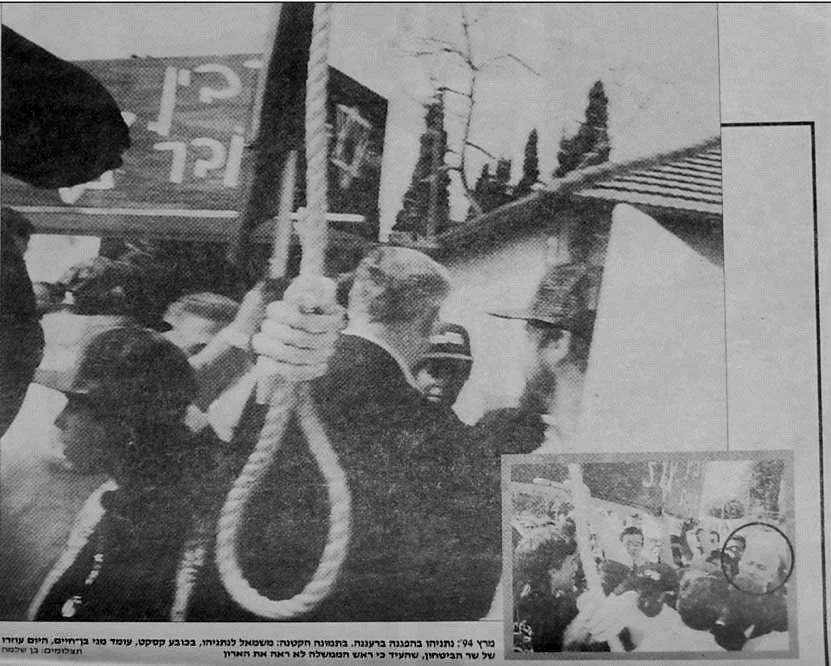
Netanyahu, who prior to the assassination of Yitzhak Rabin
marched behind a symbolic coffin of the PM-to-be-murdered, and who carries the moral
if not the criminal guilt of instigation, has now finally accomplished the
political goal of a neo-fascist government –based on an authoritarian rather
than a democratic state of mind, narrowly ultra-nationalistic and on the path
to destroy the institutions that keep the vulnerable democratic balance of
society intact. This includes the legal system, as well as the military, who,
not surprisingly to most democratic-minded Israelis but perhaps surprisingly to
outsiders, is a bastion of broadminded, ethical and civilized leadership.
Much of Israeli society is surprisingly healthy. But pathology
is nearly always stronger than health. And so, particularly under the extremist
leadership of the master-trickster Netanyahu, the extremist groups among the
most fanatical settlers, have received an informal position of instrumental
leadership, due to the consent of the political leadership. Those are the
state-threatening extremists that the Deputy Chief of the General Staff bravely
spoke about on Holocaust Remembrance Day. And it is NOT this brave soldier’s
pointing the finger at the problem that serves Israel’s enemies, but the
horrors of those extremists that Netanyahu is unwilling to reign in.
 |
| General Yair Golan |
Rather than reigning in the extremists, such as the so-called hilltop youth, the neo-fascist
government of Netanyahu wants to reign in the voices of sanity.
 |
| hilltop youth |
But there are many voices of sanity in Israel. Even though
Herzog has grossly failed as leader of opposition, many of his thoughts are
right. Thus, for instance, the Palestinian have several times rejected the
possibility of statehood, a state in peace with and alongside Israel, falling
victim to their own desire of ethnic cleansing of the Jewish population and
replacing Israel with an Arab state. Thus new ideas and solutions, including
disengagement from civilian occupation, must be raised.
This is the hour where the voice of sanity must be raised
not only by the general public, not merely by the opposition (even in its hour
of crisis), but even by those who have kept their sanity and democratic state
of mind within the coalition. Right-wing Likud MK Benny Begin has already done
so, calling the idea to appoint Lieberman Minister of Defense ‘bizarre.’ The time
has come for deposed Minister of Defense Ya’alon, as well as the center-right
party Kulanu to leave the coalition, and expose the neo-fascist right-wing
under Netanyahu’s leadership for what it is – destructive in every way to
Israel as a civilized, peace-seeking democracy.
 |
| the many voices of sanity |

Two of my books relate particularly to the psycho-politics
of Israel, The Hero and His Shadow, and aspects of the Israeli experience,
Requiem: A Tale of Exile and Return (also in Hebrew). All of my books
(including in Hebrew) can be purchased at Amazon, where you also find brief
reviews of several of the books. Any interest in my books is a welcome gift to
me, and hopefully, a contribution to the reader as well.


Tuesday, May 17, 2016
Jacob and Esau - now in French translation

En 1934, Erich Neumann quitte l'Allemagne nazie pour la
Palestine. C'est alors qu'il élabore, en correspondance avec C. G. Jung dont il
est un fervent disciple, et en marge d'une longue méditation sur le hassidisme,
ce texte fondamental sur Jacob et Esaü. A partir de Bereshit (Genèse) et des
midrasch, les jumeaux ennemis sont décrits comme un couple d'opposés. L'un,
Jacob, introverti et lunaire, représente le monde intérieur et sacré ; l'autre,
Esaü, extraverti et solaire, le monde extérieur et profane, celui de la
puissance. L'un, Jacob, représente le peuple juif, et même la "
quintessence du juif ", l'autre, Esaü, le domaine des nations. Cependant,
chacun constitue l'ombre de l'autre, son bouc émissaire mais aussi son
complémentaire, et leur réconciliation porte la promesse d'une totalité
recouvrée. A travers deux grandes figures bibliques, Erich Neumann montre ainsi
que la psychologie analytique - à la différence de la psychanalyse, et grâce au
concept d'inconscient collectif - permet de comprendre de façon non réductrice
la culture et la religion d'un peuple. Cet ouvrage doit être considéré comme
une incitation remarquable à la redécouverte du judaïsme.
Friday, May 13, 2016
Intermezzo
During the Jung Neumann Conference April 24-26, 2015, we had an opportunity to hear the Kibbutz Choir perform. Thanks to Hugh Milstein, here is a brief clip from their performance.
For those of you who have the opportunity, I will be chairing a Jung Neumann symposium which will be held, June 24-26, 2016, at Pacifica;
Creative Minds in Dialogue: the Relationship between C.
G. Jung and Erich Neumann
The symposium will feature internationally acclaimed speakers,
including Riccardo Bernardini, Lionel Corbett, Nancy Furlotti, Ann Lammers,
Lance Owens, Rina Porat, Susan Rowland, Erel Shalit, Evan Lansing Smith, Murray
Stein and Steve Zemmelman.
The recent publication of the correspondence between C.G.
Jung and Erich Neumann has brought renewed interest in both the creative
relationship between Jung and Neumann, and Neumann’s contributions to
Analytical Psychology. Months before his own death, Jung mourns Neumann as his
“friend and companion on the way,” elsewhere saying that he only had two
friends, Victor White and Erich Neumann.
The symposium will celebrate the unique contributions of
Jung and Neumann, with original presentations. Murray Stein and Riccardo
Bernardini from Eranos will be among the several prominent presenters, on
topics ranging from creativity, art, Jung/Neumann and their impact on culture
and the post-modern world, to anima and the great mother, and God, good and
evil.
The presenters will also lead discussions, with the
participation of the attendees.
For further details, please click here
Newly released: Erich Neumann, Jacob and Esau: On the
collective symbolism of the brother motif, available at Amazon.

Forthcoming: Turbulent Times, Creative Minds: The
relationship between Erich Neumann and C.G. Jung (eds. Erel Shalit and
Murray Stein).

Friday, April 1, 2016
The Cycle of Life - David van Nuys interviews Erel Shalit - transcription
You can now listen to David van Nuys from Shrink Rap Radio interviewing Erel Shalit about
The Cycle of Life
The Cycle of Life
You find the audio interview on the Shrink Rap Radio website.
A transcription of the interview has now also been uploaded, here.
 |
| Painting by Benjamin Shiff |
A Magnificent Book for All Interested in the Journey of Life
by Lori Goldrich, Ph.D., Jungian Analyst and Clinical Psychologist
It is with great pleasure that I review Erel Shalit’s
marvelous book. To begin, I feel so moved by the synchronous events that led to
his finding of the book’s cover, or “face.” Benjamin Shiff’s painting “Life”
and the meaning he gives for this marriage of book and painting are quite
exquisite. “The candle’s soft light of life is poised against the painful
inevitability of burning out. Yet, as long as they burn, there are shades and colors;
there are the distinct faces of transient existence, and there are those of
obscurity, hidden in distant nature; there is a lyrical melancholy, as well as
a tense harmony…Only an unlit candle will never burn out. A fully lived life
extracts the awareness of its finality.” These words are like pearls for the
journey he takes us on in The Cycle of Life.
I also appreciate the ground he creates by discussing fate
and destiny as a “primary tenet,” or underpinning of his book. When we let the
tides of our fate and our destiny flow together into a union of opposites,
meaning can be found. What begins as our fate can so often become a part of our
destiny, which he so aptly discusses in his book. I have found this to be an
important foundational principle, both personally and in my analytic work with
patients. “On our journey through life, an incessant tension prevails between
predetermined fate and free will, between archetypal patterns as opposed to
individual distinctiveness.” So well stated!
Erel Shalit truly succeeds in describing the different
stages of life in a way that keeps the reader interested and engaged. The
weaving of psychological and theoretical perspectives from Freud to Klein to
Winnicott to Neumann to Jung, and others, along with the wisdom from various
disciplines including philosophy, literature, religion, and myth, is presented
in such a way that both clinician and layperson can deepen in experience and
knowledge. I especially appreciate his discussion of how the focus on
archetypal images and experience can release the energy that lives in the
deeper stratas of the psyche to assist in the transformation of psyche, body
and spirit.
I also want to share a personal delight while reading Erel’s
book. I always enjoy exploring the precise meaning of Hebrew words, and I so
enjoyed his inclusion of this for select words and names. It “makes the
connection between word and image comparatively close.” It is also reflective
of the depth of attention he brings to his writing.
Erel Shalit has written a truly magnificent piece of work.
It is a book for all those interested in the Journey. At the beginning of his
book, he offers us the image of the “river” and writes from Plato, “While the
river preserves its identity, it is incessantly moving and changing,
simultaneously being and becoming.” As I read his book, I can truly experience
the being and becoming on the journey of life.
 |
| 'Life' by Benjamin Schiff |
Subscribe to:
Posts (Atom)